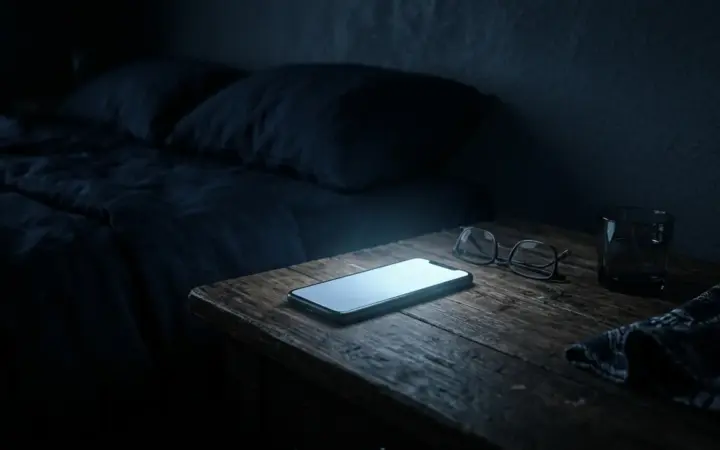
It is 10:40pm. The kitchen light is off, the fridge light is on, and you are standing in it looking at a shelf you already looked at twenty minutes ago. You are not hungry, exactly. You are not deciding, exactly. You are just there, in the cold air, with the door open, and in about ninety seconds you will be on the sofa eating something you did not plan to eat and will not really taste.
Almost everything written about this moment treats it as a willpower problem. Be stronger at the fridge door. Want it less. That advice fails so reliably that it is worth saying plainly: the fridge door is the wrong place to look. By 10:40pm the outcome has usually already been set — by what you ate at 1pm, by how the day went, by what your evening looks like when the tasks run out. Night snacking is nearly always a symptom of something earlier. The useful work is upstream.
One thing first, said once and gently. If eating at night feels genuinely compulsive rather than habitual, if it leaves you distressed rather than just mildly annoyed, if you find yourself eating while not fully awake and only piecing it together in the morning, or if any of this is tangled up with how you feel about your body — that is worth raising with a doctor. Those are real, recognised, and treatable, and they sit outside what any article can help with. Nothing below is a substitute for that conversation, and there is no failure in having it.
Why does this happen at night specifically, and not at 3pm?
Because night is when three separate things arrive at once, and they arrive together every single day.
The first is arithmetic. Whatever your body did not get during the day is still outstanding, and evening is the first time you are near food with nothing else to do.
The second is that the day is over. The demands stop. For a lot of people the evening is the first hour that belongs to them, and it is also the hour when they have the least energy left to do anything interesting with it.
The third is that night is heavily patterned. You sit in the same seat, watch the same sort of thing, at the same time. Repeated patterns build cues, and cues fire whether or not the underlying need is there.
These three feel identical from the inside. All three present as “I want something.” That is exactly why generic advice fails — it treats one problem when there are three, and the fixes for each are not just different, they actively undo each other. Eat more earlier and you will fix cause one and do nothing for cause three. Change your seat and you will break cause three and make cause one worse, because now you are hungry and sitting somewhere unfamiliar.
So the first move is not a change. It is a diagnosis.
How do I tell which of the three is actually mine?
Give it a few evenings of noticing before you change anything. You are not building a food diary and you are not scoring yourself. You are asking three questions at the moment you head for the kitchen.
- Would a proper meal appeal right now? If yes — if you could genuinely eat a plate of dinner, if your stomach is involved, if you are slightly irritable or foggy — that is the debt from earlier. Cause one.
- Would a proper meal sound faintly unappealing, while something specific sounds great? Wanting sweet, salty, crunchy, sharp — anything narrow rather than food-in-general — usually means the driver is not fuel. Cause two.
- Did you decide to eat, or did you find yourself doing it? If the sitting-down and the eating are joined, if the wanting only shows up once you are on the sofa, if the first you knew of it was the fridge light — that is the cue firing. Cause three.
Most people have more than one running. That is normal, and it does not complicate things much, because they stack in a fixed order. Fix the eating-enough-earlier layer first, because it makes the other two enormously easier. Trying to break a habit while genuinely under-fuelled is a fight you have set up to lose.
What does “eating enough earlier” actually mean in practice?
This is the most common cause by a wide margin, and it deserves the most room.
The shape is familiar. Breakfast is coffee, because mornings are compressed. Lunch is eaten at a desk in eleven minutes between two things, or skipped because a meeting ran over. The afternoon goes by on caffeine and momentum. Dinner is late and, because you have been told all day that less is virtuous, deliberately modest. Then at 10pm something arrives that feels like a lack of discipline.
It is not a lack of discipline. It is a body collecting on a debt. It has been running your entire day on credit and evening is the first moment you were both available and near a kitchen. Read that way, 10pm is not the failure — it is the correction. The failure, if the word applies at all, was at 1pm, and it did not feel like a failure at the time. It felt like being busy.
The fix is behavioural, not dietary. No numbers here, no plan, nothing to calculate. Just this:
- Eat lunch away from the thing you are working on. Food eaten while your attention is elsewhere barely registers. The same lunch, eaten with your eyes on it, lands differently and lasts longer.
- Put a real gap between the last meal and bedtime. If dinner is at 9pm you have compressed the whole day’s eating into a few hours and left nothing for the evening to sit on. Eating earlier often does more than eating differently.
- Stop making dinner the smallest meal of the day. A dinner that ends with you still slightly wanting will send you back three hours later, and the second visit is never the calm one.
- Treat a late-afternoon gap as a real gap, not a test. If there are five hours between lunch and dinner, that stretch is doing something to your evening. Something in the middle of it is not weakness. It is maintenance.
People are often surprised by how much of the 10pm pull disappears from this alone, and by how little else they had to do. If that is your cause, you can stop reading here and the article has done its job.
Why doesn’t willpower work — and why does locking the kitchen make it worse?
Because willpower is a strategy that requires you to win every night forever, and the moment you lose one, the framework tells you that you are the problem.
Look at what the loop actually does. You resolve not to eat at night. You eat at night. You feel bad about it. Feeling bad is unpleasant, and eating reliably makes unpleasant feelings quieter for a few minutes — so the shame becomes fuel for the next episode rather than a brake on it. Shame does not sit outside this pattern correcting it. It sits inside it, feeding it. Any approach built on being harder on yourself is adding petrol and calling it discipline.
The kitchen-locking family of tricks — taping the cupboard, putting food somewhere awkward, going to bed early specifically to escape — fails for a related reason. They raise the price of eating without touching the reason for eating. The want is still there, now with an obstacle in front of it, and obstacles have a way of turning a mild want into a project. And when you do get past the obstacle, which you will, the eating that follows tends to be faster, larger and considerably less pleasant than if there had been no lock at all. You have not removed the episode. You have made it more urgent and added a small humiliation to the end of it.
If a strategy only works while you are at your strongest, it is not a strategy. It is a test you will eventually fail, on a night that was already hard.
What works instead is unglamorous: remove the reason, or replace what the eating was providing. Both are addressed below. Neither requires you to be strong at 10:40pm, which is precisely the point — 10:40pm is the worst possible moment to need to be strong at anything.
What if it isn’t hunger at all?
Then you are dealing with the second cause, and it is the one people are most reluctant to name honestly, because naming it means admitting something about the shape of their days.
Here is the honest version. You got through the day. It asked a lot. Now everything is finally quiet, and out of everything available to you in this hour, eating is the only thing that is pleasant, immediate, requires nothing of you, and cannot go wrong. A book asks for attention you do not have. A conversation asks for energy. A hobby asks you to start. Food asks for nothing and delivers in seconds.
That is not greed. That is a completely reasonable response to a narrow set of options.
Which tells you why removing it does not work. If eating is the only reward in your evening and you take it away, you have not fixed anything — you have made your evening worse, and you will go back to it, correctly. Nothing rushes to fill a vacuum you created by subtraction.
So the question is not how to stop. It is what else could occupy that hour. The bar is lower than you think. Whatever you put there does not have to be edifying, productive, or good for you. It needs three things only: it should be pleasant, it should be easy to start, and it should occupy your hands or your attention enough that the fridge does not surface.
- Something with your hands while you watch — knitting, a puzzle, sketching badly, sorting photos, fiddling with an instrument. Hands are the important part.
- A hot drink you actually like, made slowly. The making matters as much as the drinking; it is a small ritual in the slot where the other ritual used to be.
- A bath, a shower, going outside for ten minutes even in bad weather.
- Something genuinely absorbing rather than half-watched. Split attention leaves a gap, and the gap is where the pattern lives.
- Messaging someone. The pull is often mostly about being alone at the end of the day.
Choose it in advance, in daylight, when you are capable of choosing. Deciding at 10:30pm what your evening should contain is a decision made by the most depleted version of you, and that version will pick the fridge every time — not from weakness, but because it is the only option that was ever actually set up.
How do I break the habit when it’s just a cue?
The third cause is the simplest and often the fastest to shift, because there is no underlying need to meet. The stomach is not involved. A sequence has been rehearsed enough times that one part triggers the next.
Sofa plus television equals eating. Passing the kitchen equals opening a cupboard. Finishing the washing-up equals one more thing. The cue fires whether or not there is any appetite behind it, which is why these episodes feel oddly hollow — the wanting arrives after you are already standing up.
You break a cue by breaking the chain, not by resisting at the end of it. Resistance is late. Change the sequence and you change the outcome:
- Sit somewhere else. The other end of the sofa, a different chair, a different room. Absurdly small, weirdly effective — most of the pattern is anchored to the physical position.
- Change the route. If your path to the bathroom or bedroom goes past the kitchen, take the other route if there is one. If not, take a glass of water with you, so the trip already has a purpose.
- Give your hands a job. Idle hands plus a screen is most of the mechanism. Occupied hands break it without any decision required.
- Mark an ending. Wiping the counters, turning off the kitchen light, putting the dishwasher on — a physical full stop tells the pattern that the eating part of the evening is over. A closed kitchen is not a locked one.
- Move the trigger, not the food. If it is the bowl on the counter you see every time you walk past, the bowl is the cue. Put it in a cupboard. That is not restriction; it is just not being asked the question forty times a day.
Expect this to feel strangely easy when it works. There was never a need to override — only a groove.
Does what’s in the house matter more than what’s in my head?
Yes, and this is where the point is easy to get wrong, so it is worth being precise.
What is visible and immediately edible gets eaten far more than what is not. Not because of weak character, but because at 10:40pm you are running on autopilot and autopilot takes the shortest path. Something on the counter, at eye level, already open, requiring no preparation, is enormously more likely to be eaten than the same thing in a cupboard behind a door.
Use that, and use it gently. Move things out of eyeline. Keep the counters clearer. Put things away in their packaging rather than open. Let a small amount of friction do the work that you were expecting your resolve to do.
What this is not is banning anything. No food in your house needs to be forbidden, and nothing you eat at night makes you undisciplined or bad. A food you have declared off-limits gets louder, not quieter — forbidding is a way of thinking about something constantly. There are no good foods and bad foods here, and if any part of this is starting to feel like rules and rule-breaking, ease off. The gentler version of any of this works better than the strict version, every time.
The aim is simply that your environment stops asking you a question you did not want to answer.
Is eating late at night actually bad for you?
Less than the internet suggests, and the honest answer is more boring than either camp wants.
Research into meal timing is genuinely interesting and genuinely unsettled. Some evidence suggests our bodies handle food somewhat differently across the day, and researchers are still working out how much that matters for an ordinary person living an ordinary life. What has not been established is any clock-based cutoff that turns eating from fine into harmful. The number in “don’t eat after 8pm” was not discovered. Someone picked it.
For most people, the meaningful issues with night eating are not about the hour on the clock:
- Automaticity. Eating without noticing that you are eating is unsatisfying regardless of when it happens, and it is the part people actually dislike.
- Amount, in context. Not because evening food counts differently, but because eating very little all day and a great deal at night is a pattern that tends to feel bad — physically and otherwise.
- Comfort in bed. A large meal shortly before lying down is uncomfortable for plenty of people. That is a personal-comfort observation, not a health rule, and if it does not apply to you it does not apply to you.
None of that makes a snack in the evening a problem. If you eat something at 10pm, enjoy it, and go to bed feeling fine, there is nothing here to fix. This article is for the version that leaves you feeling bad — not for eating after dark.
What do tiredness, sleep and alcohol have to do with it?
More than they get credit for, and they are the easiest factors to overlook because none of them look like food problems.
Being awake late is itself part of the mechanism. The simplest version: every hour you are awake and near a kitchen is an hour in which snacking is possible, and the late ones are the least structured of the day. That is not moralising about bedtimes. It is just noting that the pattern needs time to happen in, and late nights supply it.
Sleep and appetite are connected in ways researchers are still describing, but you do not need the mechanism to notice the behaviour: after a short night, food tends to be more appealing, decisions tend to be more automatic, and the evening tends to go the way the evening goes. If your nights are consistently short, that is quietly shaping your evenings, and it is often a more productive thing to work on than anything happening at the fridge.
Alcohol is worth mentioning factually and then leaving alone. It reduces inhibition generally, and that includes inhibition around eating. If your night-snacking episodes cluster on the evenings you have had a couple of drinks, that is a straightforward and well-known effect rather than a coincidence, and worth knowing simply so you can stop reading it as a character trait.
What if some nights still go the old way?
They will, and the way you handle that matters more than the streak.
Because the loop described earlier is real: an evening that ends in eating you did not intend, followed by a hard internal verdict, sets up the next one. Interrupting the verdict is a genuine intervention, not a consolation prize. The most useful response to a night that went the old way is a mildly curious one — what was different about today? Skipped lunch? Difficult day? Late night? Drinks? — followed by nothing else. No compensating, no rules, no starting again on Monday.
And keep the target honest. The goal is not to stop eating after a certain hour. It is not to have an evening free of snacks. Plenty of people eat something most nights and feel entirely fine about it, and they are not doing anything wrong. The only thing worth changing is the specific pattern that leaves you feeling bad afterwards — the standing-at-the-fridge-without-deciding part, the not-tasting-it part, the tomorrow-I-won’t part.
Change what happens at lunchtime. Give the evening something to be other than empty. Move where you sit. Then let 10:40pm take care of itself, because it mostly will.
Late eating and late scrolling usually arrive together, and for the same reason. What keeps you on the phone at midnight is the same unstructured hour. If dinner is the part that is too small, cooking for one has its own structural problem.
The NHS Eat Well pages cover the nutritional side that this article, which is about the pattern rather than the food, does not.
The World Health Organization summary of a healthy diet covers the daytime eating this article keeps pointing back to.
Frequently asked questions
How long before it feels different?
It varies by cause. If under-eating earlier was the driver, the change can show up within a few days, because you are meeting a need rather than resisting one. Cue-based habits usually take a couple of weeks of the new pattern before the old one stops surfacing. The decompression cause is the slowest, because you are building an evening you did not have before. Non-linear progress is normal and does not mean it is not working.
Should I just go to bed earlier to avoid the whole thing?
As a way of getting enough sleep, sure. As an escape route from the kitchen, it tends not to hold — you are still relying on avoidance, and it removes the evening hour without addressing why that hour was hard. If the earlier bedtime is something you genuinely want, it will help. If it is a tactic, it will likely last about a week.
Is it worse if it’s the same thing every night?
No, and a fixed nightly item is often a sign of the habit cause rather than anything to be concerned about. A predictable, deliberate evening snack that you enjoy is the calm end of this spectrum, not a problem. The version worth changing is the unplanned, unnoticed, dissatisfying one — not the consistent one.
What if I’m genuinely hungry at night?
Then eat. Real hunger is information, not a temptation to overcome, and ignoring it reliably backfires — usually later the same evening, and with more urgency. If you are hungry most nights, that is the strongest possible signal that the daytime pattern is where the work is.
When is this worth talking to a doctor about?
When it feels compulsive rather than habitual; when it causes real distress; when you are eating while not fully awake or have little memory of it afterwards; when it is bound up with how you feel about your body or your weight; or when it has simply been going on long enough that you would like a professional set of eyes on it. None of those require you to have tried everything first, and a GP is a reasonable place to start.