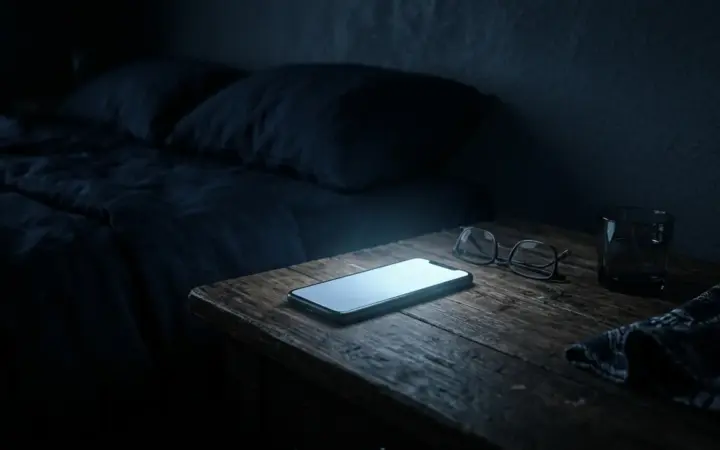
It is 12:40am. You said 11. You are three-quarters of the way through a video about a subject you do not care about, made by someone you have never heard of, and you are not enjoying it. You are not even really watching it. You are holding a lit rectangle six inches from your face and waiting for something in you to decide to stop.
That gap — between when you meant to sleep and when you actually put the phone down — is the whole story. Not the colour of the light. Not the setting you forgot to turn on. The gap.
Most writing about screens and sleep goes straight to blue light, because blue light is a tidy villain with a product attached. It is worth discussing, and we will. But it is probably not the main thing happening at 12:40am, and treating it as the main thing is why people install a filter, change nothing else, and stay exactly as tired.
One thing before we go further, said once and plainly: if your sleep has been bad for weeks, or it is affecting how you function in the day, that is worth mentioning to a doctor. There are causes of poor sleep that no article about phones can see or address, and some of them are very treatable. Nothing below is medical guidance — it is about behaviour and the room you sleep in.
What is your phone actually taking from you at night?
Start with the least glamorous answer, because it is likely the biggest one: time.
Not sleep quality, not some subtle disruption of your internal rhythm. Raw minutes. You had a window in which sleep could have happened, and the phone filled it. If you would have fallen asleep at 11:15 and you fall asleep at 12:50, you have lost ninety minutes, and no amount of arguing about light spectrums changes that arithmetic.
Researchers call this displacement, and it is the least controversial finding in the area. Screens at night are associated with shorter sleep, and a large part of that appears to be the simplest mechanism imaginable — the device is occupying the hours you would otherwise have been unconscious.
This is oddly good news. Displacement is a problem you can see, and the useful question stops being “is my screen harming my sleep?” and becomes “what would I have been doing in those ninety minutes, and how do I get some of them back?”
Is blue light really the problem?
Light does affect the body clock. That is well established — bright light, particularly at the blue end, is one of the main signals your internal timing system uses to work out what time it is. In a lab, with bright enough light, you can measurably shift that clock.
The contested part is whether the light coming off a phone held in a dim bedroom is strong enough to matter much in real life. Screens are dim compared with daylight, by orders of magnitude, and studies that try to isolate screen light specifically — as opposed to everything else that happens when someone uses a screen — have produced a mixed picture. Some find small effects on sleepiness or how quickly people drop off. Some find effects too small to be meaningful. Tests of amber lenses and night-shift modes as sleep interventions have not produced the clean wins the marketing implies.
So: blue light is not nothing. The claim that it is the primary reason you are awake at 12:40am is not well supported, and it has been repeated far past what the evidence carries.
Should you use night mode? Sure, if you like it. It costs you nothing, it is one tap, and a dimmer, warmer screen is genuinely easier on the eyes in a dark room. Just do not let it become the thing you did instead of the thing that would have worked. A warm-toned feed at 1am is still a feed at 1am.
If it is not the light, what is it?
Arousal. Not in the romantic sense — in the sense of activation. Alert, engaged, wound-up, ready.
Falling asleep is not something you do. It is something that happens when you stop doing things, and it requires a fairly specific state: unstimulated, unhurried, slightly bored. Letting go is difficult while something in your hand is actively working to hold your attention.
Consider what the last hour before bed often actually contains:
- News, which is bad by construction
- An argument in a comment thread you did not start and cannot win
- A message from work you cannot act on for nine hours but can absolutely think about for three
- A group chat moving fast that you feel slightly behind on
- Something upsetting from someone you love, delivered without warning at 11:52pm
- Video engineered, with real skill by people paid well, to be more interesting than whatever came before it
None of that is about brightness. Any of it will raise your heart rate and leave your mind with material to chew on in the dark. A calm paper book under a bright lamp will put you to sleep faster than an infuriating thread on the dimmest possible screen. Most people know this from experience and then go on discussing screen settings anyway.
The question that predicts your night is not how bright was it? It is what was it doing to me?
Why can you not stop, even when you want to?
Because there is no stopping point. This is a design decision, not a personal failing, and it is worth being precise about it.
A book has chapters. An episode has credits. A newspaper has a last page. Every older form of media contained exits, arriving whether you wanted them or not. You did not have to decide to stop; the thing stopped, and then you decided whether to continue. Those are very different tasks, and the second is far easier.
A feed has no last page. Autoplay removes the pause between one thing and the next, so the moment of choice never arrives. Pull to refresh means the well never runs dry. The whole apparatus is built so that you have to supply the ending — and you have to supply it at the precise hour when your capacity for deciding anything is at its lowest point of the day.
That is the trap. Stopping requires willpower, and by midnight you have spent all of it on work, family, traffic, and not saying the thing you wanted to say at 4pm. You are asked to make your hardest decision of the day with your smallest remaining reserve. Of course you lose. Which is why “have more discipline” is useless advice. You do not need more discipline. You need fewer decisions.
Why does “put your phone away an hour before bed” never work?
Because it asks for a large change from a tired person with no scaffolding, and it assumes you have an hour of evening that belongs to you.
For a lot of people that hour is the only unclaimed time in twenty-four. It is after the kids, after the dishes, after the last email, and it is the only stretch nobody else wants a piece of. Telling someone to give that up is asking them to surrender the only part of the day that is theirs. They will nod, agree, and not do it — correctly, on some level.
A ladder works better than a cliff. Start at the bottom rung and only move up if the one below has actually stuck:
- Change the room, not the hour. Charge the phone across the room, or in a different room. You keep it, you keep the evening; you just have to stand up to use it. Distance does more than intention.
- Cut the last thing, not the whole hour. Do not ban screens. Ban the one category that reliably wrecks you — for most people that is news, work email, or one particular chat. Everything else stays.
- Kill autoplay. One setting. It restores the endings that were removed, and endings are exactly what you were missing.
- Set an alarm to stop, not just to wake. An external signal at 11:15 costs you nothing to obey, because obeying an alarm is not a decision.
- Then, if all that holds, try the darker room and the earlier stop. By this point it is a small step rather than a leap.
Is your alarm clock the real problem?
Almost certainly, and this one deserves its own attention because it silently undoes everything else.
The phone is in the bedroom because it is your alarm. That is the reason — it is a real reason, and it is why every plan that starts with “leave your phone in the kitchen” collapses by Wednesday. You cannot leave it in the kitchen. It has to wake you up.
So the phone is on the nightstand. And once it is on the nightstand at arm’s reach, all night, everything follows from that single fact: the pre-sleep scroll, the 3am check that becomes forty minutes, the first thing you see at 6:30 being other people’s demands on you.
The fix is almost stupid in its simplicity. Buy a cheap alarm clock. Any of them. It is the highest-leverage change in this entire article, and it costs less than a takeaway. It removes the argument entirely — you are not resisting the phone, you have simply removed the reason it was ever in the room. It feels too small to matter. It matters more than the filter, the glasses and the app timer combined.
Does it matter where you use the phone?
More than you would think. Your brain is relentlessly associative — it learns what places are for. A kitchen means food, a desk means work, and those associations do real work on you before you have thought about anything.
Bed used to mean one thing: sleep. Consistently, for years, that is nearly all it was for. If you now spend an hour a night in bed alert, engaged, scrolling, occasionally annoyed, you are teaching that association a second meaning. Over months, bed stops being an unambiguous signal. It becomes a place where sometimes you sleep and sometimes you are wide awake being entertained — and your body, which is only reading the pattern you gave it, stops preparing so reliably.
The practical version: do your screen time somewhere else. Not earlier, necessarily — elsewhere. Scroll on the sofa. Watch the video in the armchair. Then come to bed when you are going to sleep. You may find you change nothing about your habits and still fall asleep faster, purely because the room stopped sending mixed signals. It has a useful side effect too: sofas are less comfortable than beds, so you get bored sooner.
What do you do instead?
The gap has to be filled with something, or you will fill it with the phone.
Paper. A physical book is the strongest substitute, not because of light but because of design. It ends. It gets heavy. It requires a small effort that a tired person naturally stops supplying, so it self-terminates at roughly the moment you should be asleep. It is the only medium that gets less compelling as you get sleepier — a feature no app will ever ship.
E-ink readers. A good middle path. The screen is dim, but far more importantly the device is boring. No feed, no notification, nowhere to accidentally end up. Devices that do one thing are your allies.
Audio. Something spoken, low volume, sleep timer on. It works because your eyes are shut. Pick something you half know already — familiarity is what lets attention slide off. New and gripping keeps you up.
Boredom. Lying in the dark with nothing to do feels like wasted time. It is not; it is the runway. For most of human history the stretch between lying down and sleeping was a slow, undirected drift — mulling the day over, arriving at ideas sideways. That drift is not a failure to be entertained. It appears to be part of how sleep begins.
We have made boredom optional, and then, because it is optional, we treat it as a problem to be solved. The first few nights of protected boredom are genuinely uncomfortable. It gets easier faster than you expect.
Which settings actually reduce the pull?
Cold turkey fails. Friction works. The aim is not to make the phone unusable — it is to make the automatic reach slightly less rewarding, so the decision to stop arrives while you still have the capacity to make it.
- Turn off autoplay everywhere it exists. The single highest-value setting on the device.
- Greyscale after a set hour. Colour is a large part of what makes a feed pleasurable. In grey it becomes visibly what it is: text and pictures of strangers. Many people find the appeal collapses within minutes.
- Turn off every notification that is not a person contacting you directly. Nothing else has earned the right to interrupt your evening.
- Move the two apps you lose time to off the home screen, so you have to search them by name. Typing the name is a moment of consciousness, and consciousness is what the automatic reach lacks.
- Log out of one at night. Not deleted, logged out. Thirty seconds of friction ends most half-hearted openings.
- Do not stack all of these at once. Two, for two weeks. Elaborate systems collapse; small ones survive.
Almost none of these are about light. All of them are about attention. That is the correct ratio.
What if your evening does not look like that at all?
Nearly all sleep advice quietly assumes a person with a predictable evening, a bedroom of their own, and no one depending on them overnight. Plenty of people have none of that.
If you work nights or rotating shifts, standard advice about evening light is sometimes backwards — your relationship with light and darkness is deliberately inverted. What transfers is the arousal principle, not the timing: whenever your sleep window is, the hour before it is better spent winding down than winding up. If the shift pattern itself is wrecking your sleep, that is a conversation for a doctor rather than something to solve with settings.
If you care for a child, a parent, or someone unwell, the phone is not a leisure object — it is what makes you reachable, and being unreachable is not on the table. Every rule involving distance has to bend. What often still works: silencing everything except the specific people who might genuinely need you, and unwinding somewhere other than the bed. You are not failing at sleep hygiene; you are running a harder version of the problem than the advice was written for.
If you share a room and have no separate space to scroll in, “do it elsewhere” is not available. Then the ladder starts lower: autoplay off, a stop alarm, the least-bad content category.
And if the phone is your only social contact at the end of a long isolated day, take that seriously before you take it away. That is a need being met. Removing it without replacing it will not go well, and it should not.
What if the phone is not the cause?
Sometimes it is not. Sometimes the phone at midnight is a symptom wearing the costume of a cause, and every screen rule in the world will slide straight off it.
Some signs to sit with. You are not really consuming anything — you could not describe five minutes ago. You feel a small dread about the day ending, or about the day starting; you are not staying up so much as postponing tomorrow. The reaching gets much worse in specific weeks, and those weeks are the difficult ones. Or you put the phone down, lie in the dark, feel your mind speed up, and pick it back up — not because it is interesting but because it is quieter than your own thoughts.
That last one is worth naming. If you are using the screen to avoid what happens in the silence, the screen is doing a job. Take away the tool without addressing the job and the job does not disappear; it finds a worse tool, or shows up as three hours of lying awake instead.
None of this is a diagnosis, and it is not for an article to say what is going on with you. Only this: if the pattern maps onto something in your life — a stretch of stress, a change, a grief, a period where things feel harder — a screen rule is not the right instrument. That is one to raise with a doctor or someone you trust, and it is a completely ordinary thing to bring up. You are allowed to conclude that the phone is not the problem.
If you are sleeping the full night and still waking up flattened, the phone may not be the whole story — there are several other reasons for that. And changing an evening pattern is a habit-design problem like any other.
What the evening screen does to your attention does not stop at bedtime. The same interruption cost runs through the working day.
The NHS covers the clinical side at sleep and tiredness, and the Sleep Foundation collects the behavioural research in one place.
The NHS also publishes practical guidance on how to get to sleep.
Frequently asked questions
Is night mode or a blue-light filter worth turning on?
Use it if you like how it looks — a warmer, dimmer screen is more comfortable in a dark room. Just keep expectations modest. The evidence that these modes meaningfully improve sleep is thinner than the marketing implies, and the real risk is that switching it on feels like you addressed the problem when the content and the hour are untouched.
How long before bed should I actually stop?
The popular figures are rounder than the evidence justifies, and a rule you cannot keep is worth nothing. Aim at a direction rather than a number: stop earlier than last night, and stop the activating things first. Twenty minutes you actually take beats an hour you fail at for a week and then abandon.
Is watching something on a TV across the room better than a phone in bed?
Usually, yes, for reasons that have little to do with the screen. It is further away, you are probably not in bed, someone else may be choosing when it ends, and it is harder to fall into an endless loop. The exceptions are the obvious ones — an autoplaying series with no gaps between episodes recreates the same trap on a larger screen.
I fall asleep with the phone in my hand and I sleep fine. Is that a problem?
If you are genuinely sleeping enough and waking up feeling reasonable, there is no rule here you are obliged to follow. What is worth watching for is gradual: bedtime creeping later, waking in the night and reaching for it, losing enough hours that the days start to suffer.
What is the one change to make if I only make one?
Buy a separate alarm clock and charge the phone outside the bedroom. It removes the reason the device is beside you all night, and it works without requiring any willpower at the exact hour when you have none left. If a second change is possible, turn off autoplay.
None of this requires you to become someone with an immaculate evening routine. It requires one or two small structural changes that mean you are not asked, at 12:40am, to make a hard decision with nothing left to make it with. Move the charger. Buy the clock. Let the room be boring. The rest tends to follow on its own.